The whole nation with one face,
looming up, striding great pace.
Remember the greater idea,
and not the one man you see.
(written by me)
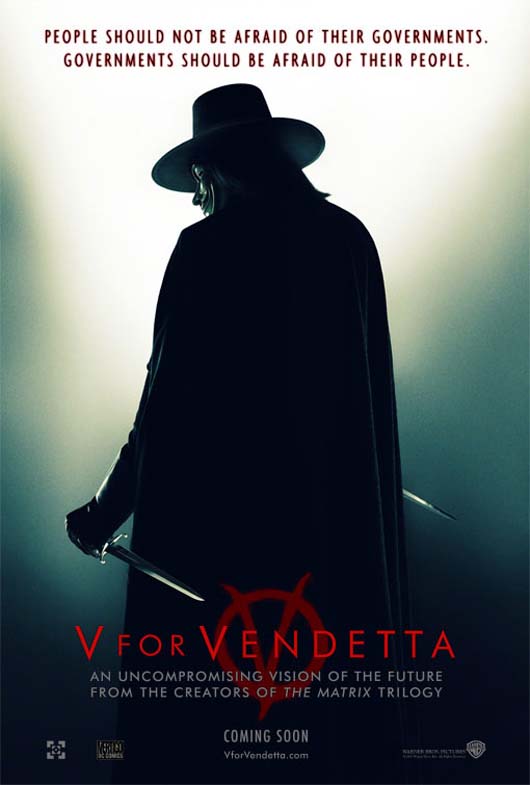
I saw the ‘V for Vendetta’ film just a couple of days ago. Sitting in a room with a couple of friends I was expecting a fighting film. However, it was nothing like that. Beginning this blog with a poem isn’t so awkward as it seems. When you’ve seen ‘V for Vendetta’ it speaks for itself.
The introduction already has some underlying clues that ‘V for Vendetta’ is not merely a fighting film. It is a poetical film. I’m not a ggod film critic, I will discuss the poetic aspects of this film. To do that properly we have do decide what ‘poetic’ is. Do we just count the poems and writings or can a landscape or happening also be poetic? If we count landscapes and happenings, how do we determine which of these are poetic? I’m not going to write a scientifically sound article, so I’ll count every thing that I find poetic as poetic. So, if you merely look at the beginning of the film, it starts off with a poetic anecdote of Britain’s history. November the 5th 1605. The day that Gay Fawkes and his companions tried to blow up the parliament building. A heroic deed, done in the spirit of the greater idea. Quite poetic if you ask me.
However, the first time the film gets to the poet within you is when ‘V’ saves Evey from the so-called ‘Fingermen’. After he gets rid of these men, in a not so poetic way, he introduces himself to Evey. As many poets after Shakespeare didn’t write plays, I’m not going to try to explain this in my own words. This quote will speak for itself.
Evey Hammond: Who are you?
V: Who? Who is but the form following the function of what and what I am is a man in a mask.
Evey Hammond: Well I can see that.
V: Of course you can. I'm not questioning your powers of observation I'm merely remarking upon the paradox of asking a masked man who he is.
Evey Hammond: Oh. Right.
V: But on this most auspicious of nights, permit me then, in lieu of the more commonplace sobriquet, to suggest the character of this dramatis persona.
V: Voilà! In view, a humble vaudevillian veteran, cast vicariously as both victim and villain by the vicissitudes of Fate. This visage, no mere veneer of vanity, is a vestige of the vox populi, now vacant, vanished. However, this valorous visitation of a by-gone vexation, stands vivified and has vowed to vanquish these venal and virulent vermin van-guarding vice and vouchsafing the violently vicious and voracious violation of volition.
V: The only verdict is vengeance; a vendetta, held as a votive, not in vain, for the value and veracity of such shall one day vindicate the vigilant and the virtuous.
V: Verily, this vichyssoise of verbiage veers most verbose, so let me simply add that it's my very good honour to meet you and you may call me V.
Evey Hammond: Are you like a crazy person?
V: I am quite sure they will say so. But to whom, might I ask, am I speaking with?
Evey Hammond: I'm Evey.
V: Evey? E-V. Of course you are.
Evey Hammond: What does that mean?
V: It means that I, like God, do not play with dice and I don't believe in coincidences.
This is poetry at its best. Besides the perfect choice of words, this scene is constructed with such precision and poetic notion. After remarking the great paradox which most of us, and I speak mainly for myself, wouldn’t have noticed, he introduces himself with an astonishing alliteration that blows your mind away. This all leads to a, sort of, humorous anti-climax by Evey’s remark. The scene ends with V’s remark about the well-chosen name of his antagonist, which of course cannot be a coincidence..
I could keep on quoting lines where V quotes some great writers and poets, but I will spare you that. I would like to use one last quote as a bridge to the point that was supposed to be the main point of this blog. In the beginning of the film an anecdote is told, about Gay Fawkes, where this line comes up.
Evey Hammond: …We are told to remember the idea, not the man, because a man can fail. He can be caught, he can be killed and forgotten, but 400 years later, an idea can still change the world...
It is hard to see the idea seperate from the man. A simple example is in physics. All the great laws of physics are called after their ‘inventors’. Take Boyle’s law, Boltzmann’s constant, Newton’s law and the Van der Waals equations. Even the greatest, in the most literal way, ideas are still coupled to a man. Religions. The Muslims have Mohammed, the Christians have Jesus and the Jews have Moses. They all have, if you can call that a man, their God.
Why are we told to remember the idea and not the man? Is it only because the man can be killed? I think the most important reason is that the man can fail. A friend of mine once said to me: “God is okay, but the ground staff isn’t any good”.
I think he summerises the whole problem some of us have with religions in this one sentence. If I ever think about God or his meaning it doesn’t seem so bad. Take a look at the Ten Commandments. "Honour your father and your mother. You shall not kill. You shall not commit adultery. You shall not steal." Some great lines some of us can learn from. However, when the Pope speaks, and talks a lot of nonsense like “Condoms are the result of witchcraft.” I turn the television or radio off as soon as possible.
I think that religion has a great value to some of us. The ones who are scared, who need some sort of assurance, who feel lonely and feel comfort in His presence. Every one has his own God and if they want to read a book they believe is written by their God, that’s fine by me, but when some stuck-up men in white dresses say they preach the word of God it has gone too far.
Believe what ever you want to believe, but don’t ever let anyone tell you that they represent your God. Your God is in your own head and your own ideas.
This is poetry at its best. Besides the perfect choice of words, this scene is constructed with such precision and poetic notion. After remarking the great paradox which most of us, and I speak mainly for myself, wouldn’t have noticed, he introduces himself with an astonishing alliteration that blows your mind away. This all leads to a, sort of, humorous anti-climax by Evey’s remark. The scene ends with V’s remark about the well-chosen name of his antagonist, which of course cannot be a coincidence..
I could keep on quoting lines where V quotes some great writers and poets, but I will spare you that. I would like to use one last quote as a bridge to the point that was supposed to be the main point of this blog. In the beginning of the film an anecdote is told, about Gay Fawkes, where this line comes up.
Evey Hammond: …We are told to remember the idea, not the man, because a man can fail. He can be caught, he can be killed and forgotten, but 400 years later, an idea can still change the world...
It is hard to see the idea seperate from the man. A simple example is in physics. All the great laws of physics are called after their ‘inventors’. Take Boyle’s law, Boltzmann’s constant, Newton’s law and the Van der Waals equations. Even the greatest, in the most literal way, ideas are still coupled to a man. Religions. The Muslims have Mohammed, the Christians have Jesus and the Jews have Moses. They all have, if you can call that a man, their God.
Why are we told to remember the idea and not the man? Is it only because the man can be killed? I think the most important reason is that the man can fail. A friend of mine once said to me: “God is okay, but the ground staff isn’t any good”.
I think he summerises the whole problem some of us have with religions in this one sentence. If I ever think about God or his meaning it doesn’t seem so bad. Take a look at the Ten Commandments. "Honour your father and your mother. You shall not kill. You shall not commit adultery. You shall not steal." Some great lines some of us can learn from. However, when the Pope speaks, and talks a lot of nonsense like “Condoms are the result of witchcraft.” I turn the television or radio off as soon as possible.
I think that religion has a great value to some of us. The ones who are scared, who need some sort of assurance, who feel lonely and feel comfort in His presence. Every one has his own God and if they want to read a book they believe is written by their God, that’s fine by me, but when some stuck-up men in white dresses say they preach the word of God it has gone too far.
Believe what ever you want to believe, but don’t ever let anyone tell you that they represent your God. Your God is in your own head and your own ideas.


No comments:
Post a Comment